 Despite the morning being rainy, the trip left as scheduled. The boat was a nice one, large and wide and very comfortable to ride in but the 1 1/2 hour trip wasn't all that smooth. I skipped breakfast this morning and was glad I did. Before we got to Corregidor, probably half the passengers were seriously seasick and throwing up. I really wasn't affected which is a good thing because when I do get seasick it tends to be violently sick.
Fortunately, as we docked in Corregidor the sun came out. From the boat we transferred into World War II trolleys for a day-tour around the island. There were seven trolley-loads of  passengers on the boat and one trolley was filled with Japanese tourists. I was wondering on the boat how that was going to work out and they separate them from the rest of the tours unless they specifically request to go on the English-speaking trolleys. There is still a lot of bitterness and hatred toward the Japanese throughout Asia and the Filipinos don't seem quite ready to forgive and forget. On the boat trip over, they showed a video of Japanese soldiers shooting and bayoneting civilians just to set the mood. About five or six Japanese students chose to ride on our trolley and the Filipino tour guide, a woman, spent most of the rest of the tour lecturing them on Japanese atrocities during the war in the Philippines. When one of them claimed he didn't know about the Bataan Death March, she lectured him for at least ten minutes--to
 the point of making everybody feel a little uncomfortable.
 passengers on the boat and one trolley was filled with Japanese tourists. I was wondering on the boat how that was going to work out and they separate them from the rest of the tours unless they specifically request to go on the English-speaking trolleys. There is still a lot of bitterness and hatred toward the Japanese throughout Asia and the Filipinos don't seem quite ready to forgive and forget. On the boat trip over, they showed a video of Japanese soldiers shooting and bayoneting civilians just to set the mood. About five or six Japanese students chose to ride on our trolley and the Filipino tour guide, a woman, spent most of the rest of the tour lecturing them on Japanese atrocities during the war in the Philippines. When one of them claimed he didn't know about the Bataan Death March, she lectured him for at least ten minutes--to
 the point of making everybody feel a little uncomfortable.
 Later, she lectured them on the Japanese use of and treatment of "comfort women" and their government's refusal to apologize for it. She also let it be known that the Japanese soldiers needlessly killed tens of thousands of innocent Filipino civilians during their occupation.
But not all was lecturing.....the tour started at the statue of General MacArthur--a historical figure I never really admired all that much.
But not all was lecturing.....the tour started at the statue of General MacArthur--a historical figure I never really admired all that much.

We then continued on past a series of caves--some Japanese and some American.
Much of the island is off-limits because there are literally thousands of live rounds of ammunition all over the place. A couple of decades ago somebody discovered the bones of some Japanese soldiers and there is a cemetery dedicated to them--ironically the cemetery and memorial are located above a bluff where hundreds of the soldiers committed suicide by jumping.

One of the most interesting side trips was a walk through the Malinta Tunnel that had been carve d out of the mountain prior to the Japanese attack on Pearl Harbor December 8, 1941 (it was the 8th in Manila because of the International Date Line. MacArthur, when notified of the attack on Pearl Harbor, commented "the Japanese must have been massacred," not knowing that the opposite was the case. Because he was afraid of saboteurs, he ordered all the American aircraft at Clark Field removed from their hangers and lined up on the runway were the Japanese air forces destroyed every single one of them the next day without losing an aircraft of their own.
 d out of the mountain prior to the Japanese attack on Pearl Harbor December 8, 1941 (it was the 8th in Manila because of the International Date Line. MacArthur, when notified of the attack on Pearl Harbor, commented "the Japanese must have been massacred," not knowing that the opposite was the case. Because he was afraid of saboteurs, he ordered all the American aircraft at Clark Field removed from their hangers and lined up on the runway were the Japanese air forces destroyed every single one of them the next day without losing an aircraft of their own.
MacArthur then moved his headquarters into the tunnel and the leader of the Philippines and his family joined him there during the initial attacks on Corregidor. Today there is a walking tour through the tunnel (which has over two miles of attached tunneling) and the tour includes stops at side tunnels for a light show explaining the events that took place inside there as the Japanese bombers were attacking the island. It was a very good program--very interesting.
After the U.S. took over the Philippines after the 1898 Spanish/American War, the army started reinforcing Corregidor since it geographically blocks the entrance to Manila Bay and the deep-water harbor facilities in Manila. By 1940 there were several large artillery batteries in place with numerous huge artillery pieces. Also, by 1940, however, air power had basically made those guns irrelevant and MacArthur had basically given the Japanese free reign in destroying our air corps. As a result, when the Japanese attacked Corregidor and Bataan, the island had been reduced to a defensive outpost and the Japanese relentlessly bombed the island. To them it was critically strategic because it would give them free access to the Manila ports. As many as 20,000 U.S. soldiers and sailors were stationed there prior to Pearl Harbor and much of the trolley tour was a trip through those bombed out ruins.
 critically strategic because it would give them free access to the Manila ports. As many as 20,000 U.S. soldiers and sailors were stationed there prior to Pearl Harbor and much of the trolley tour was a trip through those bombed out ruins.
After the Malinta Tunnel tour and show we went to the hotel on the island and had lunch. One of the old colonial buildings that survived has been made into a hotel and restaurant--something I think I would like to do if I ever come back--and we had a lunch. The sun was out in full force but there was a nice breeze and the view of the bays and jungle was about as "Robinson Crusoe-like" as I've ever seen anywhere.
After lunch, we toured some of the gun batteries but it started raining which slowed down the exploring. We went by the "Mile-long Barracks," the largest military barracks in the world at that time. They weren't actually a mile long but they were a massive structure that today is just a concrete skeleton. The Japanese bombed them relentlessly but couldn't completely destroy them and when they occupied the island the soldiers stayed in what structures were remaining. When the Americans and Filipinos reoccupied Corregidor, the U.S. bombed the remaining structures into rubble. There is an old parade ground nearby and over 1,000 U.S. paratroopers landed there and fought in "D-Day like" conditions to clear the barracks of the Japanese. Probably because of my European ancestry, I've always found the World War battles in Europe to be interesting but the fighting in the Pacific was every bit as bad, if not more brutal, than the fighting at Normandy.
 but couldn't completely destroy them and when they occupied the island the soldiers stayed in what structures were remaining. When the Americans and Filipinos reoccupied Corregidor, the U.S. bombed the remaining structures into rubble. There is an old parade ground nearby and over 1,000 U.S. paratroopers landed there and fought in "D-Day like" conditions to clear the barracks of the Japanese. Probably because of my European ancestry, I've always found the World War battles in Europe to be interesting but the fighting in the Pacific was every bit as bad, if not more brutal, than the fighting at Normandy.
The gun battery in the attached photo  was the last American gun to fall before the Japanese occupation. It was originally a naval battleship gun and there are famous photos of the victorious Japanese soldiers sitting on the barrel and celebrating.
 was the last American gun to fall before the Japanese occupation. It was originally a naval battleship gun and there are famous photos of the victorious Japanese soldiers sitting on the barrel and celebrating.
We then stopped at the Pacific War Memorial--only one of two Pacific memorials the U.S. has built (the other is at Pearl Harbor). As you would expect, it is very somber and touching. In front is a large statue of an American soldier helping a Filipino soldier who has been wounded. There is a similar statue in Atlanta, Georgia only in the U.S. the Filipino soldier is helping the wounded American soldier. The memorial itself is simple but elegant--white marble with an eternal flame.
From the Memorial we stopped at the old Spanish lighthou se at the top of the island. Spain occupied, colonized and ran the Philippines for nearly 400 years and this lighthouse guided Spanish ships into Manila harbour from the early times of the old wooden sailing ships.
 se at the top of the island. Spain occupied, colonized and ran the Philippines for nearly 400 years and this lighthouse guided Spanish ships into Manila harbour from the early times of the old wooden sailing ships.
 On the way back down to the harbor we visited the site where MacArthur raised the American flag upon his return at the end of the war. He did, in fact, return but I still think he was basically an egomaniac who dumped the deadly job of defending the island and the Philippines onto General Wainwright then claimed the eventual victory for himself.
Anyway, it was a really great day and a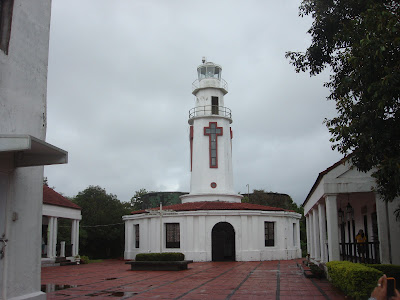 really informative trip. I'm really glad it didn't get rained out and I certainly came out of it with a new respect for what the American and Filipino soldiers went through here......
 really informative trip. I'm really glad it didn't get rained out and I certainly came out of it with a new respect for what the American and Filipino soldiers went through here......
Tomorrow, weather permitting, I hope to do a canoe trip up the Pagsanjan River to the famous Magdapio Falls and then shoot the rapids back down the mou ntain.
 ntain.


