Saturday, November 28, 2009

Finished Up the First Week…..Three to Go……

The first week wrapped up yesterday. Initially the training programs were designed to be six days in length which is very unusual and after I arrived they requested we keep it to five days which is a relief. There may not be a lot to do in the hotel on weekends but the work—believe it or not—is physically exhausting and six straight days would be tough.

The first week went pretty well. We started off with logistics problems such as training vehicles, meeting rooms, meals, etc., but that is usual for overseas jobs. Probably the next three weeks will go a little smoother.

This was a good group. They were all from Cameroon and all but one spoke really good English. The fifth student spoke almost no English at all which slowed things up for translations but he was a good student and overall the program went well.

Things at the hotel are good—one of the three English-language TV stations is an all-movie station and I’ve enjoyed the movies so far. I really don’t watch TV very much at home so I haven’t seen the movies they’ve had on the station. I prowled around yesterday and found another stairwell inside the hotel and it is really nice—well lit, clean and carpeted—and I’ve started doing some stair-climbing as a form of exercise. It makes a positive difference.

I’m taking it easy today and tomorrow and then back to work Monday. I’m trying to lay the groundwork for a trip to one of the beach villages next weekend but COTCO seems to be against it again this trip. We’ll see……

Thursday, November 26, 2009

Thanksgiving in Cameroon 2009......


Except for my short army career, I don't remember being away from home for Thanksgiving before......I thought about it some today and I really do have a lot to be grateful for.


I'm grateful for the food I've enjoyed today. The fish is simply called sole and the rest of the food is typical Cameroonian fare. One of the rice dishes is called ndole , which is made of boiled, shredded bitterleaf (a type of green), peanuts, and melon seeds. It is seasoned with spices and hot oil, and can be cooked with fish or meats. It is considered the national dish of Cameroon.


The right-hand tray above the fish contains some clear-looking balls. They are a mixture of starches--rice, potatoes, yams--that are cooked then pounded until they form a sticky mass which is then formed into balls and dipped in spicy sauces.


The sauces are typically made of a root called cassava (which naturally contains traces of cyanide), okra and tomatoes. Peppers are added and can be very similar to Thai peppers in hotness. One of the other trays contains fried plantains which I've been told are not bananas but very similar.

I'm grateful for the hotel room I have over here. It is small but safe, secure and relatively clean.


I'm grateful that I have three English-language channels on my TV set.


I'm grateful for the Internet in my room which allows me to follow the online newspapers at home, keep track of the Dynamo during trading season, and basically just maintain contact with the outside world.


I'm grateful for my friends--especially the ones that send me emails.


I'm grateful for the Skype feature on my computer that allows me to talk to Devin live almost every day while I'm over here.


I'm grateful for my home and I truly feel for the many people in the world today that live in shanties like these we drove past today.


I'm grateful for the community I'm going back to in three weeks and I really do appreciate it after traveling through poor communities like this one today.


I really do feel grateful this Thanksgiving and, like I told Devin on Skype earlier this evening, don't feel sorry for me over here. I actually have it really good......I'm really grateful for the opportunity to travel the world and visit places like Cameroon.

And lastly, I'm grateful for this fleeting but beautiful sunset outside my hotel window as I was typing this.

Happy Thanksgiving from Cameroon.


Wednesday, November 25, 2009

Half-Way Through the First Week……


…..It’s now Wednesday evening and I’ve done three days work this week which means I’m half way through the first of four weeks over here. As is typical in Cameroon, things got off to a rough start logistically but are starting to smooth out and probably will be ok for the remainder of the job. The hotel I’m staying in is the same one as when I was here two years ago and there have been some upgrades which make it a little nicer but it is still in many ways a gilded cage. It is secure and safe, relatively clean and has a good restaurant—all of which makes it one of the nicest hotels in the country—but there is absolutely nothing to do outside of my room.

Security is so tight here that when I went out the front door to take a picture of the front of the hotel, the doorman came running out to stop me. I guess he thought I was going to go walking down the street. Inside the hotel, there is a small lobby connected to a lounge and then the restaurant. All this consists of the first floor. There is a small walled patio outside the restaurant that has the swimming pool but there are really no grounds to the hotel—no place to walk, run or exercise. I thought about walking up and down the stairs but they are hot, smelly and filthy. No, I didn’t see any bats but I’m sure they’re there somewhere. They take two-hour lunches in Cameroon and I considered taking my running shoes and trying to walk during lunch, but the work area is a hard-hat and steel-toe boot area and it’s too hot and humid anyway.

Like I said earlier, conditions are pretty nice at the hotel but it is just so restrictive. COTCO is headquartered in Douala but our meeting site is outside of town on the Wuori River at a site called Lima Base. The river here has been dredged and there are some pretty large vessels moored. This morning we saw a long dugout canoe with about twenty people in it. They had large cloth bags and were dressed in native African clothing typical of this area. One of the workers said they were probably refugees from Gabon. Douala itself is about 1.6 million people but they are spread out in a network of small villages.

To get to Lima Base we have to drive through one of these villages on a dirt road and it is everything you imagine impoverished Africa to be. There is one well in the center of the village with a concrete wall around it and there are always people there filling plastic bottles with water. There is a “free medical clinic” there but I’ve never seen it open on my trips here. There are literally hundreds of small children—many can hardly walk they are so small—and you can tell they are starving and sick. This is one of those areas where you don’t take photos and I wouldn’t feel comfortable doing it anyway. We really don’t realize how fortunate we are in the States…..

Which brings me to the subject of Thanksgiving tomorrow. I’ll have lunch with the group out at Lima Base and then I will probably splurge a little for supper at the hotel. Pretty sure there’ll be no turkey though……


Sunday, November 22, 2009

It Took Nearly a Full Day, But I Made it to Douala…..

…..From the time I left my front door until the time I checked into my room, it was a 22 ½ hour trip but that included over six hours layover at the Paris airport. For the most part, the trip went smoothly with only minor glitches.

On the flight from Paris, one of the passengers came up to me on the plane and introduced himself. He was the head of security for ExxonMobil here and he remembered me from two years ago. We had a good talk at the airport and he will be giving me a detailed personal security orientation as part of my first-day initiation on Monday. I’ll also have a detailed medical orientation and will be issued a malaria survival kit—I have started the mandatory anti-malarial medications yesterday and will take it daily until a week after I’ve returned to Friendswood next month.

As far as personal security, not much has changed since the last job here however there was a recent taxi strike that turned violent and there have been public demonstrations in support of the taxi drivers. One of the fallouts of that is that cameras and photography—always restricted—are both very touchy subjects right now.

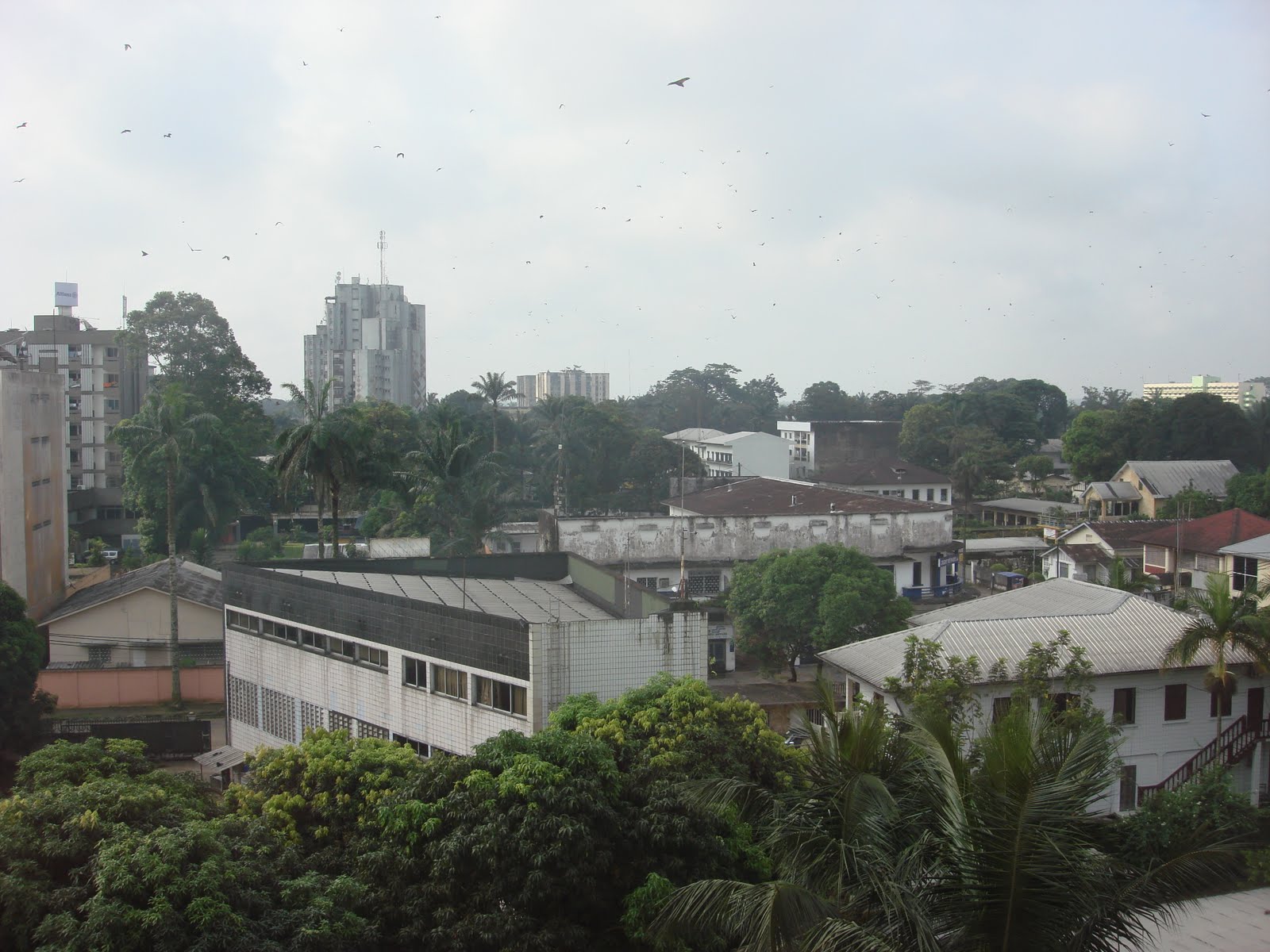
At the airport, COTCO met me and walked me through the complicated customs and passport issues here and arranged a minibus to the hotel. I had tried to change hotels but they overruled me because of security reasons and booked me in the same hotel I was in two years ago. I checked in—the typical room above the fourth floor facing away from the street—and and the room is much nicer than last time. One major upgrade is free Internet access in the room so I should be able to post regularly and email every day. I’m including a photo I shot out of my room window this morning.

I hardly slept during the trip so I had a full night’s sleep last night and we’ll see how quickly my body adjusts to jet lag today. I went down and had lunch earlier and was only moderately hungry—we’re seven hours ahead of Texas so it was breakfast time and I don’t eat much breakfast. I have a $141 per day meal allowance while I’m here and, believe it or not for one of the poorest countries in the world, it will cost me about that much to eat here. One favorable thing I do remember about this hotel from last time is that the food was good and safe—and that in itself is a major plus. Of course, you pay for it…..

Another upgrade from last trip is that the room now has two English-language channels—CNN and BBC. I also get Al Jazzera, but it’s in French. And I now have a flat-screen TV in the room. Life is good and I will come across a lot of people this coming month that have little food, no electricity and no drinkable water. I feel under house arrest in the restricted confines of the hotel but it is really a very good and safe environment that most Cameroonians will never experience in their lifetimes.

I’m basically spending this first layover day taking it easy—watching TV, playing with the Internet and trying to adjust to jet lag. The work begins tomorrow and I’m really looking forward to it. I’ll be training Cameroon COTCO employees to teach their tractor-trailer transport drivers safety techniques in hauling fuels and hazardous chemicals in dangerous driving conditions. This is what I enjoy doing—this and working with embassy drivers for the State Department—and it sure beats doing the basic instruction myself in downtown Houston as I’ve done almost all year in 2009.

We had a “bat invasion” just now outside the hotel. I’d forgotten about them, but several times a day there are literally thousands of bats that come out and swarm in huge circles around the city for fifteen or twenty minutes then go back to wherever they stay during the day. I’ve been told the underground parking garage at the hotel is like a cave with the ceiling covered with bats. I remember seeing some of them in the stairwells but never in the hallways or rooms. Actually, the locals here are big fans of the bats—they swarm several times a day and eat probably millions of mosquitoes. And mosquitoes are the biggest cause of malaria—one of the biggest medical problems here and a huge killer of children in this country. I tried to take a picture but they’re really small and really fast…..

I’ll eat supper a little later and will probably be a little more hungry and will sleep at least several hours tonight. It usually takes me two to three days to make the full adjustment after I arrive. I’ll try to post regularly but the photos may be few and far between. So far, off to a good start……

Tuesday, October 27, 2009

Making My Fourth Trip to Cameroon in November.....

.....which means I'll be on the road for Thanksgiving but will be home six days before Christmas.

This will be my third job with this company--called COTCO, or Cameroon Oil Transport Company (subsidiary of Exxon)--so I know what I'm getting into.

I'll be working in Douala, a major port city on the coast and within the shadows of Mt. Cameroon. In the past, I've been pretty much restricted to work and the hotel but this trip I'm going to make every effort to get out at least a little bit which may be hard since I'm working 27 straight days with only three Sundays off.

Cameroon is a hardship assignment but I can't complain since I've been to places like Cairo, Cape Town and Manila since my last trip here.....I guess you have to take the bad with the good.

I'll be posting more information as I learn more myself......

Saturday, September 19, 2009

Dos Gringos in Pachuca, Mexico.....(Loco Gringos to boot......)

Devin and I just got back from one of the most enjoyable “international” trips I’ve ever made—to the mining city of Pachuca, Mexico located about two hours northwest of Mexico City to take part in what was almost a“pilgrimage” to see a Pachuca soccer match.

I know most of the people who read this blog aren’t all that familiar with the sport of soccer but to Mexican soccer fans, at least one trip to Pachuca during a lifetime is considered a pilgrimage given the storied history of the club there.

Pachuca is the birthplace of North American and Mexican soccer and the first Pachuca team was founded by Cornish tin miners in the mountains here in 1901. That makes the club 108 years old and it is an internationally-known club—in fact, just last year they placed fourth in the Club World Cup playing against teams from Africa, Asia, South and North America and Europe. You aFlways hear about English and European soccer clubs like Liverpool, Chelsey, Manchester United, Barcelona and Milan but last year Pachuca placed higher in the world than all but one of them (Manchester United won the championship). The clubs in Mexico City always measure themselves against Pachuca and the matches are always packed with fans, often violent, and filled with passion.

This is it: Mexican Soccer Mecca. There is no equivalent in U.S. sports—Pachuca is the Mexican version of the New York Yankees, Boston Celtics and Dallas Cowboys all combined in one franchise, year after year, for 108 years.

Devin and I have both wanted to see a game here since we’ve become Houston Dynamo fans. Actually, there is some history between the two clubs—Houston has beaten Pachuca twice in Houston and Pachuca has beaten us twice in Mexico (Pachuca rarely looses to anybody in Mexico). This game was September 16—his birthday—and as a present, we went down there against the advice of almost everybody we talked to.

We flew out of Houston that morning to Mexico City and logistically, things started going wrong almost immediately. We landed in Mexico City about a half-hour late and it took us nearly two hours to clear customs. Despite the recent bad blood between the Mexican and U.S. national teams this summer, we both wore our bright orange Dynamo jerseys and drew a lot of stares but nobody gave us any trouble.

From the airport we had planned to take a bus to the Mexico City north bus station then connect to Pachuca. Since neither of us speak particularly good Spanish, that was the part of the trip I considered most stressful. Once we cleared customs, though, we were so far behind schedule we decided to take a taxi directly to Pachuca—very expensive but a good investment in hindsight.

We arrived at Pachuca and checked into the Holiday Inn there. Pachuca is still today an active mining town—a working-class community of over a million people located about 8,200 feet above sea level and one of the highest towns in Mexico in terms of elevation and coolest in terms of temperature. We ate supper at the restaurant there and Devin was able to contact the Houston Dynamo front office over the Internet and actually established contact with the Dynamo Chief Operating Executive who was surprised to learn anybody had made the trip from Houston. He also later called Devin on his cell phone and arranged to get us free tickets to the game. This is like a sports fan being contacted by someone like Jerry Jones of the Dallas Cowboys or Drayton McLane of the Houston Astros—pretty impressive that the Dynamo would take that kind of effort to support visiting fans!

We also learned that the game has been delayed two hours because of television coverage so that gave us a little room but I’m still glad we took a taxi instead of negotiating the bus schedules.

Like I said before, Houston and Pachuca have a short but competitive history and when the North American tournament brackets were announced last spring the Pachuca front office publicly stated they wanted another match up with Houston. The two teams play well against each other, respect each other, and to promote this match the Pachuca front office offered free tickets to the whole stadium. Try to imagine the Los Angles Lakers or Chicago Cubs doing that for an important game! Predictably the result was a packed stadium—between 25,000 and 30,000 fans. Our orange jerseys started really standing out in the crowd!

Despite that, we decided to make a twenty-minute walk up the side of the mountain to the stadium instead of taking a taxi about an hour before game time. Again, we got tons of strange stares and some taunting but nobody gave us any real trouble. That would be a recurring theme throughout our two-day stay there—lots of taunting (about 90% of it good-natured) but we never ran into a single real jerk looking for trouble. For the most part, I think we were considered novelties and possibly maybe even “crazy Gringos.”

We got to the stadium and were walking around looking for “will call” to pick up our tickets when Devin got another call from the Chief Operating Officer and he had sent a security officer to meet us with the tickets. We got inside the stadium and noticed the tickets had no seats marked on them—we didn’t realize the game had been opened up free to everybody and there were no assigned seats. We just started looking for a good spot and accidentally stumbled into what was their ultra, hard-core support section which would have been a HUGE mistake but a security officer stopped us and radioed somebody else who sent a contingent of Hidalgo State Police to escort us.

Despite the fact the stadium was “sold out” due to the free tickets, one section is always reserved for visiting supporters. You have to remember that these matches, especially with Mexico City clubs, tend to be very violent and security is very tight here—also very efficient.

We were escorted to the “visitors section” and guess what, out of nearly 30,000 soccer fans that night, there were only two orange Dynamo jerseys in the stands. We were literally “surrounded” by Hidalgo State Police about five feet apart. I am attaching a short video here that I took in which I can count 44 of them around us. To view the video, click on the little triangle in the lower left corner--it may take a couple of seconds to buffer but should then play. I would also mention that not a single one of


them looked like someone you would want to start trouble with. We had a “contact” that spoke pretty good English and was very good to us. We didn’t do it, but he told us if we needed to use the restroom, they would literally shut one of the men’s rooms down for us and escort us there. Once inside the security ring, I don’t think we were in any danger at all!!!

As expected, it was a really good game and, as expected, the Dynamo lost 2-0 but we were never really predicted to win against the No. 4 club team in the world, in their stadium, at 8200 feet. It really was a "David vs. Goliath" match, but it was a good game and well worth our trip down there. Nobody really gave us any trouble and several people actually came up and welcomed us to Pachuca and expressed surprise we were there. We had fun, showed “the colors,” and displayed our flags and cheered for the Dynamo. I traded club scarves with one of them and a number of their fans asked us for other Dynamo gear.

We were held in place until the stadium was nearly empty then escorted to the entrance and then, a little surprisingly, turned loose into the remaining crowd to get back to the hotel. We decided to walk rather than take a taxi and made the walk with some friendly taunting but no problems. Of course, if the Dynamo had won, it would probably have been much different.

The next morning we slept in, ate breakfast, and took a taxi to the old historic downtown area of Pachuca. This area is a long ways from the border and almost nobody spoke very much English, so we were really on our own.

Pachuca is a very old and historic mining town and even today quarries are located throughout the city. Much of the architecture here is stone masonry—walls, aqueducts, and old buildings. In many ways, it has the feel of an English village because of the rock masonry. We visited the landmark of the city, the Monument Clock Tower, in the heart of the historical district. As they are proud to boast, there are only four of these particular clocks in the world—Big Ben in London, the Canadian Parliament in Ottawa, and another in France.

We went inside the base of the tower and signed up for a city tour on a small bus. We were, as usual, the only Gringos, but a young kid who spoke pretty good English joined the bus with us and gave us a personalized interpretation while the main guide spoke to the others in Spanish. Overall, it worked out pretty well.

We rode around the city center looking at old historic buildings, the Hidalgo Supreme Court, and some convents and old churches. We stopped and went inside the Church of San Francisco—the oldest church in Pachuca and very ornate and beautiful.

The tour also went up the side of the mountain and stopped at the huge, and I mean huge, statue of Christ overlooking the city. We returned to the clock tower at the end of the tour and Devin and I ate at one of the restaurants on the main plaza. The food here is obviously “Mexican” but not Tex-Mex like you get in Houston. There are some similarities such as tortillas and tacos, but it really is a type of Mexican food all in its own.

The food item that Pachuca is famous for is a Mexican version of the Cornish pasties where a small meal is rolled up in crust and formed into a pastry containing a meat, potatoes, vegetables and a dessert. The restaurant we ate at was out of them at the time, so we ordered off the menu.

After lunch, we decided to take a taxi back to the soccer stadium for some more pictures of the outside and in doing so managed to stumble into one of the most pleasant surprises of the whole trip.

Devin collects photos of himself in front of various stadia in his Dynamo jersey with his scarf and we hadn’t found the main entrance the night before (and it might not have been a good idea at the time anyway) so we took a taxi there and walked around looking for the main entrance sign. One of the side gates was open so we went in and were stopped by a little, older man who was the gate guard and spoke no English whatsoever. After stumbling through an explanation and pointing to my camera, he let us wander around inside the stadium.

The Pachuca stadium is literally the showpiece of Pachuca. It is a really nice stadium and that day the only other people there were the cleaning staff doing their thing after last night’s game. Devin and I shot pictures of each other against the backdrop of the club name in the stands and were leaving when the little old man stopped us again and motioned for us to follow him.

He then took us to the luxury boxes, through the stands themselves, and gave us a personalized tour. He didn’t speak English but I think he understood we really respected and admired the Pachuca tradition. I don’t think many other Gringos have ever had such a tour—at least such a two-on-one personalized tour. He then took us to the press box and other locations in the stadium. We then got on an elevator with him and went down about three or floor stories and then, to our amazement, we stepped out onto the playing field! Only a die-hard soccer fan would probably appreciate this—but it was an almost unprecedented thing to see this famous and historical stadium grounds from this perspective.

He also took us down a long hall which was basically a museum—a hallway of historic photos including the 1901 Cornish team, photos of all the trophies and international matches and tournaments during the past 108 years, and pictures of famous Pachuca players and moments. Every visiting team that plays here has to run through this tunnel to get on the field—could be pretty intimidating!

We thought the “tour” was over when he took us through one more door and to our amazement, we were in the Pachuca locker room. As you would expect with this club, it was much like a spa in a five-star luxury hotel. We got to go into the pre-game meeting room where the team meets before each match. It is designed in a circle with each player having a designated seat and his life-sized photo and framed jersey behind the seat. One of those spots belongs to Jose Torres, a kid from Longview, Texas. Visiting here is something even organized tours don’t get to do and we are quite possibly the only two people on the face of the earth to visit here wearing Dynamo jerseys.
Secondly only to the game itself, this was the highlight of the trip! From the stadium we walked back down and found the local sports shop where Devin got an official Pachuca club scarf from the 2008 Club World Cup in Japan and we headed back to the hotel, stopping at the local bus station and buying tickets back to the airport for the following day.

We had visited a lot that day, walked quite a few miles, and got back tired. After showering, we hit the business center, checked emails and Devin called Alida. We ate a fairly light supper and called it a day.

The third morning we got up early, checked out of the hotel, and walked down to the bus station. It was surprisingly easy to negotiate and we got on our express bus to the airport with no problems. The trip back was going great until the engine overheated and we had to stop while the driver poured bottle after bottle of drinking water in the radiator to get the temperature back down and we took off again only to have stop shortly later at a filling station where he poured buckets of water in the radiator but he did get us to the airport ok—and basically on schedule.

At the airport, our flight was delayed but Continental got us on a flight an hour earlier. After we had boarded, we sat there at least an hour because of maintenance problems then were told to disembark because the flight was cancelled. Our original flight was still delayed but after standing in line for what seemed two hours we got back on it and it left a couple of hours behind schedule but we made it back to Houston ok.

All of this took place in just 48 hours but it was one of the best and most enjoyable trips of this nature that I’ve ever taken. I’m sure it will be a birthday Devin will always remember and we’ll both have stories that will be told and retold for years to come.
As Devin pointed out during the trip: "Fortune favors the bold." We went boldly where few other Dyamo fans have ever gone. Of course, we may have had a little help.....

Wednesday, September 09, 2009

Final Observations On My Next-to-Last Day in the Philippines.....and a Westerner's Guide to Riding a Jeepney.....


I have a class tomorrow but it will probably wrap up a little early so one of the students can catch his return flight back home. The 3-day refresher program has been a real pleasure--I have one Filipino student and others from Burma (Myanmar), Cambodia, Taiwan and Vietnam (the south, in Ho Chi Minh City). They are all experienced trainers and have done the training before so it is just a refresher.

It's been raining really hard here for several days now but the sun finally came out this afternoon--just in time for me to leave. No matter, I've really enjoyed my stay and the job here.

Yesterday afternoon, I decided to take the plunge and ride a Filipino Jeepney. I decided on a simple ride--to Intramoros which is directly down the coast from the hotel along the main boulevard. The problem would be catching the right Jeepney for the four blocks to the main boulevard. I asked the front desk at the hotel which sign to look for in the front window of the vehicle and they almost freaked out. They kept telling me to take a taxi and I kept saying I wanted to ride a Jeepney. Finally they offered to take me there in the hotel shuttle bus but I stood firm and they told me the name to look for on the Jeepney. They also told me the word to yell at the driver to get him to stop--both were words I'm not sure I could pronounce which didn't matter anyway because once I walked out into the street I forgot both of them.

So I got a pocketfull of small change and wandered out into the street in front of the hotel. I think the bellhops may have been taking bets on me. Since I forgot the name to look for, I just tried to flag down the first Jeepney that came by in the direction I wanted to go. He never slowed down but it looked like he had a full load. I'm not sure but he may have given me the finger as he went by.

The second one slowed down--they don't really stop--and I grabbed one of the back handles and swung into the back of the bus and sat down. Once seated, I looked around and guess what, I got into a Jeepney full of young school girls. School must have just gotten out and there were about fifteen of them sitting there looking at me like I was some kind of foreign monster. It probably didn't help that I was wearing a bright orange Houston Dynamo soccer jersey (I like to try and blend in with the locals).

I handed my seven pesos up to the front and sat there with my knees basically touching my chin in the cramped back of the vehicle. The Jeepney was going parallel with the main boulevard in the direction I wanted to go so all was well....to start with. The going was slow because of the heavy traffic then, about three blocks into the drive, the driver turned right which is not were I wanted to go. First time he slowed down again, I swung off then walked back to the original street and caught another one, paid my seven pesos, and was headed toward the bay and the main street. This time I was in a really crowded one with all kinds of people and they were sitting shoulder to shoulder and some of them had obviously been working outside in the rain all day. At the main boulevard, the Jeepney turned, but the wrong direction so I hopped off again. I crossed back over and attempted to flag one down the other direction but didn't have any luck and finally gave up and walked back to the hotel. I do think the bellhops were surprised to see me make it back alive.

I told my students about it today and the Taiwanese, Cambodian and Burmese students decided they wanted to try the same thing today. If I don't see them tomorrow morning, they're probably circling around Manila somewhere in a Jeepney trying to figure out where to get off.

The Jeepneys so impressed me I've posted a separate post just on them below with lots of pictures.

Tuesday, September 08, 2009

The Ubiquitous Jeepney.....


The Jeepney, as the name suggests, began after World War II when the U.S. Army started scrapping wartime jeeps. The Filipinos would take the junked vehicles and through various ingenuous ways, get it running again and use it as a taxi in post-war Manila when almost nobody had any money. As a result, these improvised taxis initially only charged the smallest coin being used by the postwar government. Today the standard rate is still only about 7 Philippine Pesos, or 18 U.S. cents.


With time, the Filipinos began expanding the back of the jeeps to include a bed with bench seats. Today the bed frames have grown to the point where they can accommodate 25-30 people but during rush hours and after rain downpours there may be nearly twice as many. Old pictures of Jeepneys show packed beds with another ten or fifteen people hanging on the back or even the sides--dangling off the outside while holding onto a window post. You still see this once in a while, usually with kids, but the police have been discouraging the practice.


At the Jeepney "factory" I visited (there are
several around Manila), there was no real factory or assembly line as you would expect in America or Japan. In fact, it looks more like a junkyard at the entrance--one section is littered with old engines, another with rear axles, and still another with suspension systems and drive trains. All Jeepneys are custom-made and the potential buyer sorts through the "junk" and chooses the power train assembly then begins designing the frame. Since the frames have extended to become small buses, the drive trains are almost always custom made from standard (usually Japanese) parts.


The expanded frames are all similar in design but do have individual variations to the buyer's specifications. Today, most frames are made of stainless steel--which means the body will last forever and never rust--but stainless steel is very expensive and requires somebody who knows what he's doing to weld the parts. When the U.S. Navy abandoned the giant Subic Bay naval port and maintenance facility they left behind a mountain of stainless steel and that is now being used for these Jeepneys.


Some of the vehicles are still regular sized--the one photo shows a rebuilt one with an over sized Mercedes Benz emblem on the radiator. Others, like the solid stainless steel vehicle in the photo below it, are almost completely built by hand.

Since they last forever it is not unusual to see some of the original World War II-era vehicles still running on the streets but it's nearly impossible to tell dates since everything is custom built anyway. At the "factory" there was a 1955 model on display. If you look at the fender ornaments, they should look familiar from a U.S. model in the 1950s but I can't quite remember
what they are off of.


The engines are almost all from Japan. Buyers go over there and purchase them in bulk. Usually they are junked out engine blocks with the metric equivalent of 200,000 to 300,000 miles on them and the Filipinos rebuild the blocks from scratch and get at least that many more miles out of them. For some reason, Isuzu truck engines are very popular and most are diesel. With no effective pollution control laws in effect in Manila and the fact these have little, if any, muffling systems that means that they are constantly sending out a black plum e of diesel fumes as they go down the streets. During congestion, when twenty or thirty of them are backed up idling, it is almost impossible to breath as you walk down the sidewalk beside them.

When the custom order is finished, it is truly a work of art but might not be for everybody's taste. They are, however, elaborate and do reflect the buyers personal preferences--as in the photo of the one with about thirty rear-view mirrors mounted on the hood along with a chrome horse.


Monday, September 07, 2009

My Third Off-Day Was A Rainout so I Visited the Church of the Black Nazarene.....

I pretty much took it easy--especially in the afternoon. This morning I slept in then ate breakfast at the top floor of the hotel and watched the rain pour down on Manila Bay. Around 9:00 it let up and I headed out for one of the sights I'd been wanting to see since I've been here--the Quiapo Church which is north of the Old Walled City.

Quiapo is home to one of the oldest churches in the Philippines, dating back to 1586, but the current building was built in 1933 and over the centuries several buildings have fallen to fires, earthquakes and Japanese and American bombing during World War II. it is most famous, however, as the home of the Black Nazarene--an image of Christ that is believed to be miraculous. The life-sized statue was carved of dark wood in Mexico by Aztec carvers and carried by Spanish galleon to the Philippines in 1606. Catholic tradition holds that the wooden ship caught fire--charring the white image into the current black statue. The church today was rebuilt in a very distinctive Mexican colonial architectural style.

Even by Catholic tradition, this statue is almost considered frightening in the manner in which its devotees worship it. The sick come from miles away, often crawling on their knees in submission, and twice a year the image is carried on the shoulders of tens of thousands of frenzied devotees in one of Manila's biggest religions festivals. The ability of the image to gather large crowds and work them into a religious frenzy has frightened more than one dictator here. At Easter, the image is also paraded and you may have seen the pictures of the crowd--some of whom march in the parade lashing themselves with whips until they are bleeding. Although the government and the Catholic Church have banned it, there are still some fanatical followers who literally are crucified on crosses with the nails driven through their wrists and feet. It is probably the most fanatical following of any Christian symbol anywhere.

It was raining lightly when I left the hotel so I took a taxi to the church which was a good thing because the church is located in what is referred to in Manila as "Chinatown" and I probably would never have found it on foot. As it was, the taxi dropped me off and I walked about three blocks through the Chinese market area consisting of stalls and food vendors. I don't scare easily but I felt more than a little uneasy threading my way through the crowd and stalls. When I reached the church there was a Mass in session and I slipped in through a side door to get out of the rain and stood for most of the service which was in Filipino.

As the crowd left, I moved to the back of the church and the main entrance where the statue is kept. I spent about ten minutes just watching the crowd--they were literally lined up to just touch it. Some would wipe towels on it and then cover their faces praying while others would place a Rosary or religious emblem on the wood and pray. I didn't really feel comfortable taking a picture so I stepped outside the entrance and shot a photograph from outside and even then the guard motioned me away.

The plaza in front of the Church, Plaza Miranda, was once a popular gathering place for Filipinos to hold parades and festivals but a bombing in 1971 killed several people and led to a period of martial law in the Philippines. Today there is a monument there but people seem to avoid it except to enter the church.

From Quiapo I took another taxi to Intramoros--the Old Walled City. I had been wanting to walk around the top of the wall and look at the old military bastions. When I got there it started raining and I walked around about half of it and had to really be careful because the stones were slippery and I've already got a sore knee from slipping on the steps of the lighthouse on Corregidor. I do find Intramoros fascinating although the walls are almost in total ruin due to World War II. I shot a photo of the main entrance today and am attaching an old picture of the main entrance at the end of World War II during the Battle of Manila when the U.S. Army retook the city from the Japanese. Today almost everything inside the old city is rebuilt, including the Manila Cathedral where I stopped and took some photographs.

After about half-way, it was pouring and I was drenched and realized I wasn't enjoying it anymore so I walked back to the hotel. My running shoes are completely soaked and I showered, ate a really good lunch at the hotel and took a nap and spent the rest of the day in the hotel and the rain never really let up.

I've got a three-day job starting in the morning and head back to Houston Thursday night. Overall it was a good three-day weekend despite the weather.....

Contributors